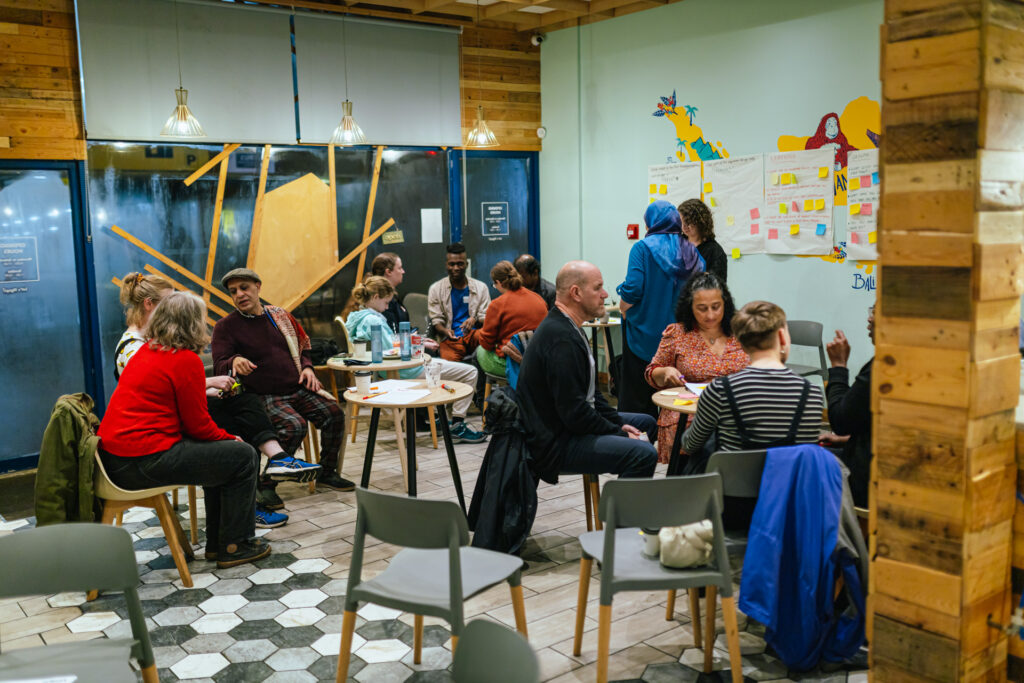
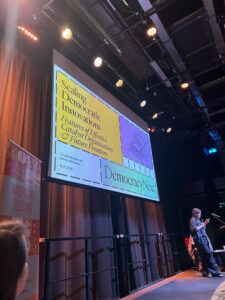
 Hosted by Democracy Next, this forum explored the need to transition from traditional representative models (where elected officials are viewed as agents for their constituents) to a ‘deliberate wave’ of democracy, spearheaded by citizen assemblies. The core argument was that current political systems fail because they rely on self-selection and assertiveness, which naturally exclude those living in poverty, migrants, people with disabilities or those with language barriers.
Democracy Next expressed sortition as a possible solution, whereby organisations can purposefully curate a ‘mini-public’ that reflects the true diversity of society. This structural shift would ensure that decision-making power is not in the hands of the few but is instead redistributed through learning, rotation and deep deliberation.
A key component of this model is the ‘learning phase’, in which participants are briefed by both technical experts and individuals with lived experience. This helps to empower citizens, many of whom may not have much prior knowledge on a topic, to make informed decisions on complex issues.
The transition to a political model where democracy is a deliberate part of the citizen assemblies raises critical questions regarding their design. If participants are given access to information and expert teachings that the average citizen does not have, there is a risk of creating a new gap between the assembly and the public that they represent. Furthermore, the pre-planning phase remains a controversial point. Mapping and identifying marginalised communities requires a high degree of transparency to ensure bias doesn’t shape who is included in conversations.
To be truly democratic, the mapping and planning of these assemblies must be as rigorous and inclusive as the deliberation itself. This is something that we actively work towards at The Social Change Nest, hosting groups such as Our House, who build public awareness of and demand for democratic systems change, incubating Brent Giving, who operate a Participatory Grant Making community program, and supporting the Participatory Grantmaking Community, who we hosted a dinner with during our time in Oxford.
The Audacious Project was joined by Tiko, an organisation working to strengthen the resilience of girls across Africa, and Ipas, who work with partners around the world to advance reproductive justice, to claim the importance of girl-centred care systems across the African continent.
Millions of adolescent girls between the ages of 15 and 19 face overlapping barriers to health, education, safety and economic opportunity. To support their families financially, these girls are often forced to drop out of school to marry early. This also exposes them to the ‘Triple Threat’ – sexual violence, HIV/AIDS, and unintended pregnancies, narrowing their chances of having productive and good livelihoods.
Unfortunately, responses from funders, organisations and even governments are disconnected from the realities faced by these girls. Although there is attention on supporting them, it is often quite short-term and characterised by fragmented funding, siloed policies and disconnected services. As a result, it’s the symptoms of the challenge that are addressed, rather than the root causes, making long-term and profound change superficial.
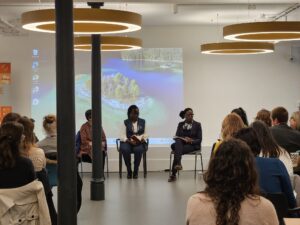
The three organisations ended the discussion by emphasising that if we want to create long-lasting impact, we need to move towards more integrated, feminist, and girl-centred care systems.
Through the Urban Movement Innovation Fund (UMIF), we have supported youth climate groups whose impact extends across communities, advancing opportunities for women and girls throughout the Global Majority. To date, we have distributed over USD 1.5 million to individuals, organisations and groups worldwide. This includes Garima from Nepal and Chido from Zimbabwe, both of whose projects centre on creating safer spaces for women and girls. We spoke with them as part of our blog series on the UMI Fund.
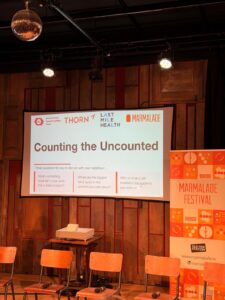
Another event hosted by the Audacious Project united Humanitarian OpenStreetMap Team (HOT), Last Mile Health and Thorn in a panel discussion addressing the importance of ‘counting the uncounted’, referring to individuals in rural communities and those most vulnerable to humanitarian and climate disasters.
HOT is a global non-profit using open mapping to support humanitarian response and community development. They have mapped over 1 billion people in low and middle-income countries using WhatsApp and drone imagery, aiming to empower local communities to do the mapping themselves, and to train them to be a key part of the local structure.
HOT’s maps have been used by other humanitarian organisations, including Last Mile Health, which supports more than 23,000 community health workers to provide access to primary care to over 33,000 people in Liberia, Ethiopia, Sierra Leone, and Malawi. In Liberia, they have used mapping combined with satellite imagery and machine learning to identify remote and isolated communities for health service planning.
Lastly, Thorn, an organisation dedicated to fighting child sexual exploitation, uses data mapping and AI to identify victims and map the digital infrastructure of abuse. Through their Spotlight tool, they also help law enforcement officers map online footprints of perpetrators.
The panel concluded by emphasising the significance of humanitarian mapping in making the ‘unseen seen’ so that those living in the most vulnerable areas can access the services needed to thrive. There was also a shared focus on ethics, with all three organisations agreeing that those contributing to mapping work should have control over what they share. They also highlighted the importance of recognising the divide between public and private imagery in their work.