
SPEAK OUT! Don’t Be Silenced: A Message to Funders and Larger Institutions
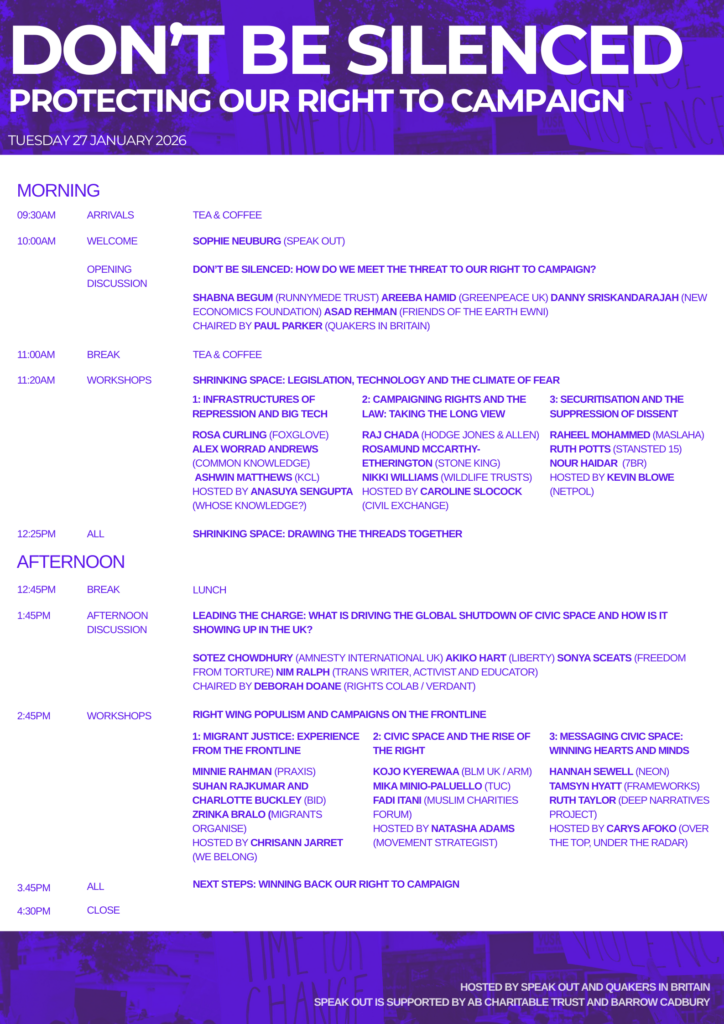
Last week we attended a day-long event in London led by one of our groups: SPEAK OUT!
In a full-to-capacity venue, with an audience ranging from grassroots groups to regulatory bodies and large NGOs, we gathered for ‘Don’t Be Silenced: Protecting Our Right To Campaign’. One theme kept resurfacing in different forms: civic space doesn’t only shrink because governments legislate. It shrinks when everyone else quietly adapts and lets it.
‘Temporary measures’ become permanent, language shifts, and fear does its job. Civil society, especially bigger, better resourced parts of it, starts making decisions that feel sensible in the moment but collectively shrink what’s possible.
If you’re a funder, a foundation, a large charity, or a national institution, this is the part that matters: Your risk appetite is now a front line. Being silent is a huge risk.
Across the day, people described how pressure shows up inside organisations: anxiety, resource drain, burnout, and self-censorship. You see it in communications that become bland, in campaigns softened to avoid complaint and in funding decisions that quietly move away from ‘sensitive’ work, especially racial and migrant justice, because it’s seen as riskier.
Civic space shrinks when risk becomes associated with anything that might attract attention. Protecting civic space means recognising that public accountability, human rights, and community organising will increasingly be targeted, and we have to decide, consciously, not to abandon them.
Grassroots, place-based groups are the future
One of the strongest ideas from the day was the need to rebuild civil society from the ground up, with a localised, rooted approach that’s more human and less performative.
Many national organisations are not deeply rooted in the communities they claim to serve. That gap is now a strategic weakness because it becomes easier to portray campaigners as an elite other, rather than ordinary people defending ordinary rights.
Place-based grassroots groups are how legitimacy is rebuilt and protected. They connect issues to everyday life, make the stakes visible and hold local power to account. Unfortunately, they’re often the first to be hit by hostility, yet the last to be resourced to withstand it.
If you fund big institutions but starve local organising, you end up with a sector that can write reports about injustice but can’t shift it.
We firmly believe that place-based networks, groups and movements are perfectly placed to create solutions in areas that large organisations aren’t, and we can prove it. That’s why we’ll be hosting Wild Times later this year, an event that will look deeper into place-based initiatives and how local communities are responding to challenging situations. Keep your eyes peeled in the coming months for more information and tickets.
Speak out! Institutionally, not just individually
A recurring question in the room was “Are we already self-censoring?”
If you’re a larger organisation, your voice carries disproportionate weight. When you go quiet, it sends a signal across the ecosystem: “Don’t touch this.” When you speak, you create cover for everyone else.
Speaking out doesn’t have to mean party politics. It can look like:
- Defending the legitimacy of protest and dissent
- Naming threats to civic space
- Challenging the narrative that campaigners and protestors are deviant or dangerous
- Backing peers when they are targeted with complaints or investigations
- Refusing to treat “controversy” as proof of wrongdoing.
Silence is also a message. Right now, it’s often the message opponents want you to send.
Fund tech security like it’s a core mission
One of the most practical calls to action from the day was that funders should support and fund work on tech accountability and security.
The reality is that many organisers and campaigning groups are increasingly shaped by:
- Harassment and doxxing
- Account takeovers and phishing
- Surveillance and data exploitation
- Platform manipulation and disinformation,
- Insecure devices, weak access controls, and limited support when something goes wrong.
This work is rarely funded properly because it sits in the awkward category of overheads. But it isn’t just an overhead. It’s safety and resilience. It’s also enabling infrastructure like insurance, safeguarding, and financial systems, which The Social Change Nest can support groups to navigate.
If you want brave work, you need to underwrite the conditions that make bravery survivable.
Fund:
- Digital security audits and support
- Training and ongoing coaching
- Secure tools, password management, device security, and access control
- Incident response capacity (what happens when something goes wrong)
- Tech accountability work that tackles platform harms at a systems level.
What adjusting risk appetite actually means
‘Be bolder’ is cheap advice. Here’s what a real shift looks like in practice:
- Make your risk framework pro-civic-space, not merely pro-compliance. If your framework treats complaints, investigations, or hostile media as automatic red flags, you are effectively outsourcing strategy to bad-faith actors. Update your assessment so “being targeted” is not treated as “being wrong.”
- Provide cover, not just cash. Offer public support when partners are attacked. Fund legal advice and wellbeing support. Pay for extra capacity if it’s needed. Back organisations when scrutiny hits, instead of disappearing.
- Fund the messy middle. Movement-building, convening, coalition work, and community organising often look untidy. They’re still the engine room keeping us going.
- Shift from short-term grants to resilience funding. Multi-year, flexible funding gives groups the ability to plan, build capacity, and respond under pressure without burning out.
- Share power and reduce duplication. Support coordination so grassroots groups aren’t forced to reinvent tools, training, or safety systems in parallel. Fund shared infrastructure and a cross-campaigning resilience platform of resources, providing support and advice to the whole sector.
We’re currently stuck in a model where funders provide wraparound care to their own grantees only, when the resources could be shared and used by everybody. By acting in solidarity and creating a free, easy-to-use platform with a variety of tools, everyone in the sector could easily find the help they need.
- Resource place based organising intentionally. Make a commitment to providing core funding, local leadership development, and the ability to act quickly when local conditions change.
A closing challenge
The right to protest is one of the few tools accessible to everyone. If it’s successfully reframed as suspicious or criminal, we don’t just lose a tactic, we lose a basic mechanism of democracy.
So here’s the challenge coming out of SPEAK OUT:
- Choose differently.
- Speak out.
- Fund grassroots, place based power.
- Underwrite tech security and resilience.
- Adjust your risk appetite so that you’re not accidentally collaborating in the shutdown of civic space.
You can’t fix an issue without involving the people at its heart. Those with lived experience and knowledge of the problem or area. At The Social Change Nest we support place-based groups not just as a fiscal host, but by doing all we can to keep them safe and provide the information, training and reinforcement they need.
If you’re interested in getting funds to place based groups, please book a call or email aroa@thesocialchangenest.org.